
By Elsa Imdad
Like all catastrophes, this escalation exposes pre-existing fault lines, with Afghan women bearing its most acute and cumulative burdens.
The cross-border escalation between Pakistan and Afghanistan since late February 2026 has unfolded in a context in which Afghan women already live under some of the most restrictive conditions in the world. In this sense, the airstrikes, shelling, and cross-border clashes, which have affected at least ten provinces, do not introduce instability into an otherwise stable environment.
Assessments by Afghanistan’s Operational Gender Coordination Group show that women and girls make up more than half of the nearly 90,000 people affected by the escalation. This alone illustrates the gendered nature of the crisis. A considerable number of communities now report that women are unable to reach health facilities. In others, access is dependent on a male guardian, or obstructed by the lack of female health workers. These constraints are not new, but increased insecurity has made them far more difficult to navigate.
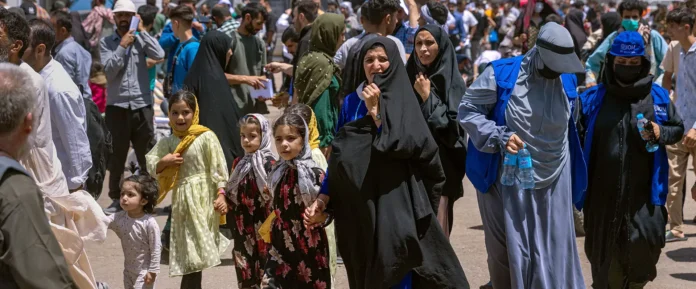
Daily routines have altered in visible ways. Women describe a shrinking of the physical spaces they can safely enter. Markets, water points, clinics, and even communal latrines in displacement sites are avoided due to fear of airstrikes, harassment or the unpredictable behaviour of armed personnel at checkpoints. In Kabul, many families now prevent women from leaving home entirely. Men have taken over tasks that women previously managed, not because roles are shifting, but because the risks have risen to such an extent that families are unwilling to expose women to them. As one woman explained: “We no longer feel safe going outside or continuing normal life.”
Women without male relatives are facing the sharpest difficulties. Female-headed households, which are already among the most vulnerable in Afghanistan, encounter compounded barriers when attempting to secure aid, travel for medical care or obtain basic supplies. The requirement of a mahram, documentation checks and mobility restrictions intersect to limit even essential movement. In such circumstances, the difference between food security and hunger, or between life and death during a medical emergency, can hinge on the presence of an adult male relative.
The escalation has also collided with earlier disasters. In parts of Kunar and Nangarhar, many women who were displaced by last year’s earthquake have now been uprooted a second time. Several have spent months in temporary shelters, often without adequate services, only to face new waves of insecurity that force them to move once again. Many intend to return to their damaged villages despite the absence of water systems, health facilities or safe housing. Their decision is not a choice in the true sense. It is a response to the insecurity and overcrowding of displacement sites, and to the near-total absence of sustainable alternatives.
Economic pressures have intensified as well. A majority of affected women report loss of income as their biggest challenge since the escalation. Even home-based workers are unable to maintain activities due to disrupted supply chains, rising prices and the inability to travel. Household-level coping strategies reveal the strain. Reports of inadequate child-feeding practices have increased, and many women are reducing their own food intake so that children may eat. These indicators point towards a longer-term nutritional and health crisis if conditions persist.
The psychological impact of the escalation is significant but less visible. Women speak of anxiety, sleeplessness and a constant sense of dread following airstrikes. Access to mental health support remains extremely limited. Most women rely on informal networks and religious or community-based coping mechanisms to manage stress. While these provide some comfort, they are not sufficient when insecurity is prolonged and when women have already endured multiple rounds of displacement, loss and uncertainty.
The gendered consequences of this crossborder conflict are not newl. They arise from pre-existing gender inequalities in Afghanistan that conflict exacerbates. When women’s mobility is restricted, insecurity amplifies isolation. When employment opportunities are scarce, conflict reinforces dependency, and women are excluded from public life, their needs do not surface in assessments or policy responses with the urgency they require.
This has direct implications for the humanitarian response. Access itself is gendered. Where female staff cannot be deployed, women’s needs are under-reported. Where aid distribution does not account for mobility constraints, women are less likely to receive assistance. A more effective response requires deliberate efforts to ensure that women are included in assessments, that women-led organisations are supported to reach affected areas, and that female-headed households receive targeted assistance that reflects their heightened vulnerability. It also requires ensuring that women-only services remain operational and are staffed by female workers who can safely travel.
The broader challenge lies in how such escalations are framed. When the conversation is limited to military strategy or political signalling, the human cost disappears into the background. Afghan women’s experiences should neither be peripheral nor episodically acknowledged. They offer the clearest insight into how conflict reshapes society at its most fundamental level.
Afghan women continue to sustain families and communities under conditions that would overwhelm many societies. Their resilience is often highlighted, but resilience should not be romanticised. It is frequently the only available option in a context where choices are severely constrained. As tensions between Pakistan and Afghanistan persist, there is a real risk that the specific ways in which this escalation is affecting women will fade from international attention, absorbed into the long sequence of crises that have come to define Afghanistan. It is high time to acknowledge that the experiences of Afghan women are not an adjunct to the story of conflict. They are central to understanding its true cost.
The data for this piece came from: UN Women. Gender Alert 2: Impacts of Military Hostilities between Afghanistan and Pakistan on Women and Girls. Kabul: Operational Gender Coordination Group, April 2026.
AUTHOR
Elsa Imdad is a USG Alumna. She holds a bachelors in modern languages with an English major and Spanish minor. She has previously been part of American Spaces in Pakistan and now works as a Senior Project Coordinator at the Center for Research and Security Studies. She is also a weekly contributor for Matrix. Her interests include public diplomacy, language teaching, peace and conflict resolution, capacity building for marginalized groups, etc.