
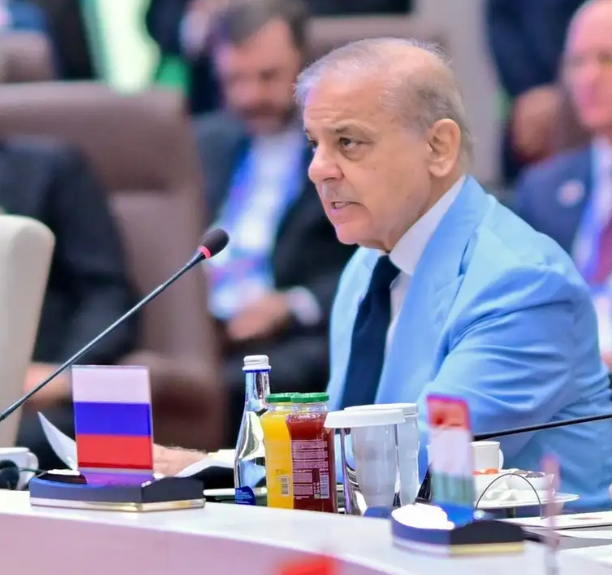
Pakistani Prime Minister Shehbaz Sharif told the Shanghai Cooperation Organisation summit in Bishkek on Tuesday that lasting regional peace would remain impossible while terrorist groups use Afghan territory to attack Pakistan and other neighbours.
Referring to Pakistan’s record in combating terrorism, Sharif said the country had suffered more than 90,000 casualties and economic losses exceeding $150 billion over the past two and a half decades.
He said Pakistan, as chair of the SCO’s Regional Anti-Terrorist Structure, had worked to strengthen security cooperation among member states.
The Pakistani prime minister said Islamabad wanted a peaceful, stable and prosperous Afghanistan, but lasting peace in the region would remain out of reach as long as armed groups used Afghan territory to attack Pakistan and neighbouring countries.
The Taliban has repeatedly rejected the allegation, saying it does not allow Afghan territory to be used against other countries. Islamabad, however, says the Taliban must take tangible and verifiable action against armed groups before tensions can ease and dialogue can resume.
Concerns about armed groups operating in Afghanistan are not limited to Pakistan. Tajikistan has also repeatedly warned of security threats emanating from Afghanistan and the possibility of instability spreading into Central Asia. Recent attacks and clashes along the two countries’ border have heightened those concerns.
Disputes between Pakistan and the Taliban over the presence and activities of armed groups have sharply strained relations in recent months, affecting trade and the operation of border crossings.
Meanwhile, SCO leaders stressed in the final declaration of the Bishkek summit the need for an inclusive government with broad participation by representatives of Afghanistan’s ethnic and political groups. The Taliban has previously said its government is inclusive and includes all ethnic groups.
In another part of his speech, Sharif called for greater regional connectivity, saying the China-Pakistan Economic Corridor could link regional economies to the Arabian Sea.
He also reaffirmed Islamabad’s support for railway projects, road connectivity and regional energy initiatives, and called for the full implementation of the SCO Development Strategy through 2035.
Sharif said the establishment of an SCO Development Bank would be an important step towards that goal. He added that during Pakistan’s presidency, Islamabad would also prioritise cooperation in information technology and artificial intelligence, energy, poverty reduction, disaster management, health, culture and sport.
Pakistan has assumed the SCO’s rotating presidency for 2026–27, with the organisation’s next summit scheduled to be held in Islamabad in 2027.
Sharif expressed hope that the SCO would become an organisation that prioritises cooperation over confrontation and dialogue over division.
Pakistan assumes the organisation’s presidency as Afghanistan’s security situation and the activities of armed groups in the country remain major regional security concerns.
Source: Afghanistan International