

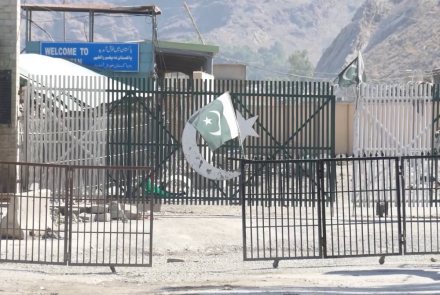
More than three months have passed since all of Afghanistan’s commercial crossings with Pakistan were closed, and so far there have been no signs from either side that these routes will be reopened.
However, the Deputy Minister of Agriculture, Irrigation and Livestock told TOLOnews that the problem still persists and that Afghanistan’s exports to Pakistan will not resume until a fundamental solution is reached.
Sadr Azam Osmani added that during this period, the government has worked on alternative routes, and currently Afghanistan’s agricultural products are being exported to India, the United Arab Emirates, European countries, China, Russia, and Central Asian countries.
Osmani said: “At present, our products are not going to Pakistan, and we are trying to resolve this issue because Pakistan is a good market for us. Until the problem is fundamentally resolved, exports to Pakistan will not take place, and we have worked on several alternative routes.”
The deputy minister also spoke about the smuggling of goods from Pakistan, saying that based on the policy of the Islamic Emirate, no imported goods from Pakistan are currently allowed to enter the country, and even if such goods enter through other routes such as Iran, they will be returned.
He stressed that the Islamic Emirate is committed to this decision and wants trade relations with Pakistan to be organized in a way that existing problems are resolved and Afghan farmers are no longer harmed.
The Deputy Minister of Agriculture, Irrigation and Livestock added: “If rice comes through Iran but is originally from Pakistan, it is returned, and even chicken chicks and fish that come from that country are returned. Therefore, the Islamic Emirate is committed to its words, and we want to have trade with Pakistan in a way that our farmers are not harmed.”
Meanwhile, a number of economic experts, considering the interdependence and closeness of the Afghan and Pakistani markets, emphasize the need to find a sustainable solution to this problem and call on the government to make greater efforts to create and expand alternative markets.
Mir Shaker Yaqubi, an economic analyst, said: “India and Bangladesh have good capacity to absorb Afghanistan’s products. In addition, there are Central Asian countries such as Uzbekistan, Turkmenistan, Tajikistan, and Kyrgyzstan. If appropriate mechanisms are put in place for exports to these countries, we can, in the long term, fill the gap left by Pakistan.”
The Ministry of Agriculture, Irrigation and Livestock has also stated that several countries, including Russia, China, Iran, and Central Asian countries, are currently interested in cooperating with Afghanistan in the agricultural sector and have held discussions with officials of the Islamic Emirate in this regard.
Source: Tolo News