

Pakistan said on Thursday it was open to a bilateral mechanism proposed by Afghanistan’s Taliban government to address security disputes but warned any dialogue would depend on Kabul taking verifiable action against militants Islamabad says launch attacks from Afghan soil.
The response came after Afghan Interior Minister Sirajuddin Haqqani proposed dedicated committees on both sides to coordinate over militant activity and said Taliban authorities would act on evidence provided by Pakistan.
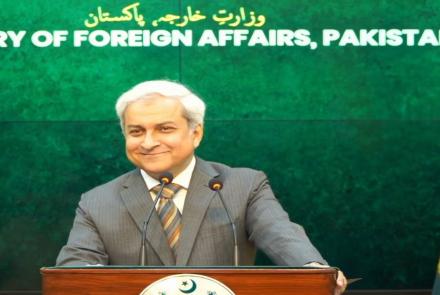
“Pakistan notes the proposal by the Afghan government’s interior minister for a dedicated bilateral mechanism to address contentious issues,” Foreign Office spokesperson Tahir Andrabi told a weekly briefing in Islamabad. “We remain open to state-level dialogue.”
“However, the sustainability of any mechanism will depend on tangible actions rather than mere assurances.”
Haqqani said during an interview this week that Afghanistan had introduced restrictions on the movement of foreign armed groups and was prepared to act against militants if Pakistan shared evidence about their activities.
He proposed coordination committees through which the two countries could exchange information and said bilateral engagement, rather than mediation by other countries, offered the best route for resolving their disputes.
Andrabi said any dialogue required the Taliban authorities to ensure Afghan territory was not used for attacks against Pakistan.
“Kabul must honor its international commitments, including those under the Doha Framework, and ensure that Afghan soil is not used by hostile proxies, particularly the TTP and BLA against Pakistan,” he said, referring to the Tehreek-e-Taliban Pakistan and Baloch Liberation Army.
“We remain ready for institutional coordination, provided it results in tangible and verifiable counterterrorism measures and effective border management.”
Relations between Pakistan and Afghanistan have deteriorated sharply since the Taliban returned to power in Kabul in 2021, with Islamabad accusing the authorities there of sheltering militants responsible for a surge in attacks inside Pakistan. Kabul denies the allegation and has repeatedly said Pakistan’s security problems are an internal matter.
The dispute has increasingly spilled over into direct confrontation.
Pakistan and Afghan forces fought their worst clashes in years along the border in October 2025, killing dozens and prompting Qatar and Türkiye to broker a ceasefire in Doha. Subsequent talks in Istanbul failed to produce a lasting settlement as the two sides remained divided over Islamabad’s demand for action against militants operating from Afghanistan.
Hostilities escalated again in February after Pakistan carried out airstrikes inside Afghanistan, saying it was targeting militant infrastructure following deadly attacks at home. Afghan forces retaliated, triggering weeks of cross-border fighting and further Pakistani strikes.
Tensions had already risen in late 2023, when Pakistan began a sweeping drive to expel undocumented foreigners, overwhelmingly affecting Afghans, after authorities said Afghan nationals had been involved in militant attacks.
The two countries share a roughly 2,600-km (1,600-mile) frontier, and Pakistan says lasting normalization of relations depends on the Taliban preventing militants from using Afghan territory to plan and carry out attacks across the border.
Source: Arab News