
By Elsa Chandio
A new survey shows how Taliban restrictions and donor cuts are narrowing women’s role in aid, even as organisations struggle to remain operational.
Afghanistan’s humanitarian response has not stopped because women were banned from aid work. Instead, it has been pushed into a daily negotiation over whether women may enter an office, travel to the field, speak to beneficiaries or remain employed at all. Separate workspaces, mahram costs, field-only arrangements and temporary exemptions now determine how much of the aid system can still include women.
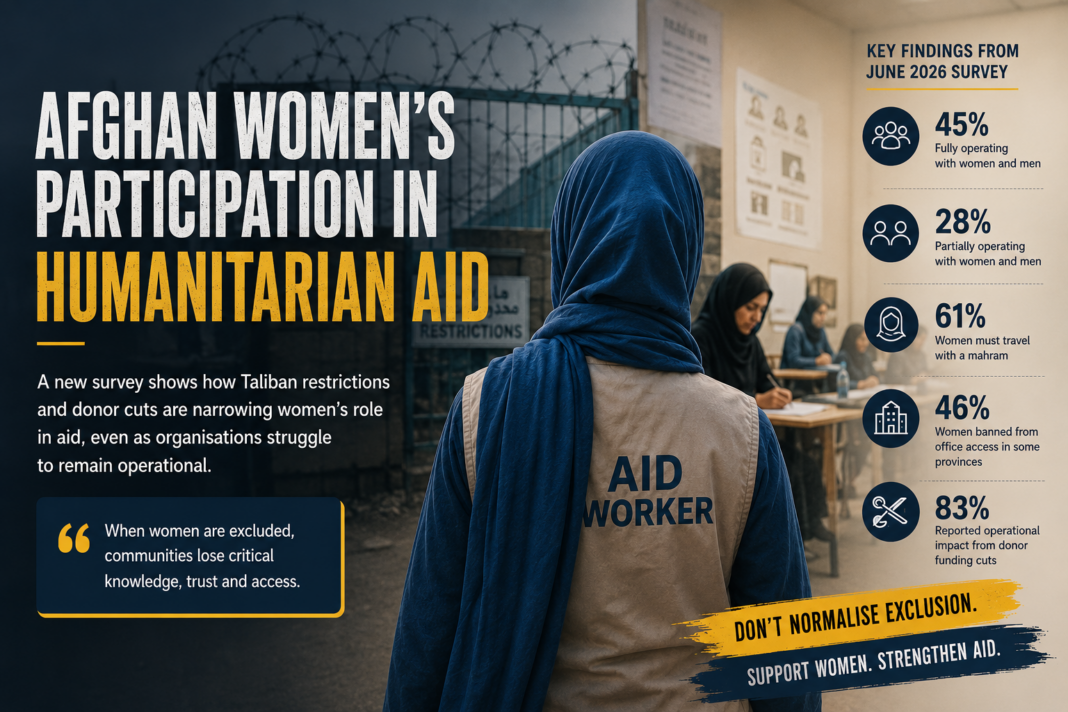
A new tracking report by the Afghanistan Gender Coordination Group and the Humanitarian Access Working Group shows how precarious this arrangement has become. Based on responses collected in June 2026 from 122 organisations working across 34 provinces, it finds that 45 per cent are fully operating with both women and men, while another 28 per cent are partially operating with both. Those figures might sound reassuring. They are not.
Organisations are staying open by navigating rules that make women’s participation conditional and easily withdrawn. At the same time, donor cuts are taking away the money needed to maintain separate workspaces, provide safe transport, cover mahram-related costs and negotiate local permissions. The result is a humanitarian system being squeezed from both sides: the Taliban restrict women’s work, while shrinking budgets make those restrictions harder to overcome.
The problem can no longer be understood as a collection of separate bans. The December 2022 prohibition on Afghan women working for national and international NGOs, its extension to the United Nations in April 2023, and later enforcement barring women from UN premises have developed into a wider, systemic control over where women work, how they travel and whether they can exercise authority inside aid organisations.
61 per cent of responding organisations said women staff now had to travel with a mahram on journeys they previously made alone. 46 per cent reported that women could no longer report to offices in some provinces where they had once worked, while 39 per cent said women could no longer join official missions. Almost a third said women had been excluded from awareness-raising activities, and 28 per cent reported that women staff were increasingly stopped by morality officials on their way to or from work.
Each restriction weakens the link between humanitarian organisations and the women they are meant to reach. When women cannot travel, enter offices, conduct outreach or join assessments, agencies lose knowledge that male-only teams cannot simply replace. A programme may remain open on paper while becoming less capable of identifying protection risks or delivering services women can safely use.
Over four years of working with Afghan women through CRSS’s Beyond Boundaries programme, I have seen the distance between being invited into a process and being able to participate meaningfully. Our dialogues have brought together Afghan women peacebuilders, religious scholars, civil-society actors, researchers, journalists and young people to discuss girls’ education, women’s right to work, refugee protection and the humanitarian consequences of conflict. These women brought direct knowledge of how insecurity, displacement, border closures and restrictions are experienced inside families and communities. When women are missing, the analysis itself becomes poorer.
Aid organisations have responded with ingenuity. 68 per cent use separate workspaces for women and men, 65 per cent provide transport or financial support for mahram accompaniment, and 58 per cent rely on women working only in the field. Three-quarters had successfully negotiated permission for women’s fieldwork, and just over half for office reporting. These efforts have kept women employed and assistance moving.
Yet resilience is not a sustainable settlement. 75 per cent of organisations had to accept conditions such as mahram accompaniment, gender separation or field-only work. Others accepted increased monitoring or official involvement in implementation, staff selection and procurement. These permissions are usually limited to a particular activity, place or period. Revocable exceptions are replacing a woman’s right to work.
Donor funding cuts are making this system even more brittle. 83 per cent of respondents reported at least one operational impact from reduced funding. 44 per cent could no longer cover costs associated with women’s participation, including mahram arrangements, and 32 per cent could not maintain separate spaces or working hours. More than a quarter had reduced their geographic footprint or closed field offices. Only 35 per cent of the women-led organisations surveyed had received new project funding since December 2025.
Financial retreat and gender restrictions now reinforce each other. The authorities impose costly, discriminatory conditions, while shrinking budgets leave organisations less able to work around them. When transport, additional premises and separate shifts cannot be funded, excluding women becomes cheaper. 14 per cent of organisations already operate fully or partly with men only.
Operational status, therefore, offers little comfort on its own. It does not show whether women can enter an office, travel safely, influence decisions or reach female beneficiaries. Keeping an organisation open is not the same as preserving meaningful access for women.
Donors should treat women’s participation as a core cost of humanitarian access. Multi-year, flexible funding should be protected for women-led Afghan organisations and for the arrangements that keep women staff working. This support is a response to coercive rules, not an endorsement of them. Funding agreements should also require clear evidence of how women shape programme design, assessment and monitoring.
Humanitarian agencies also need a stronger collective negotiating position. Separate local bargains allow conditions to shift between provinces, sectors and officials. Shared red lines, coordinated documentation and confidential reporting would make concessions harder to withdraw quietly. Yet 38 per cent of surveyed organisations do not report gender-related access constraints to OCHA, often because they are unaware of the mechanism or fear repercussions.
Afghan women cannot remain a negotiable component of the humanitarian response. Nor can women-led organisations be expected to carry the burden of access while competing for an ever-smaller share of funding. The survey’s most troubling message is not that aid has stopped. It is that the system is learning to function around women’s exclusion. The longer that adaptation continues without sustained funding and collective pressure, the more permanent the exclusions will become.
AUTHOR
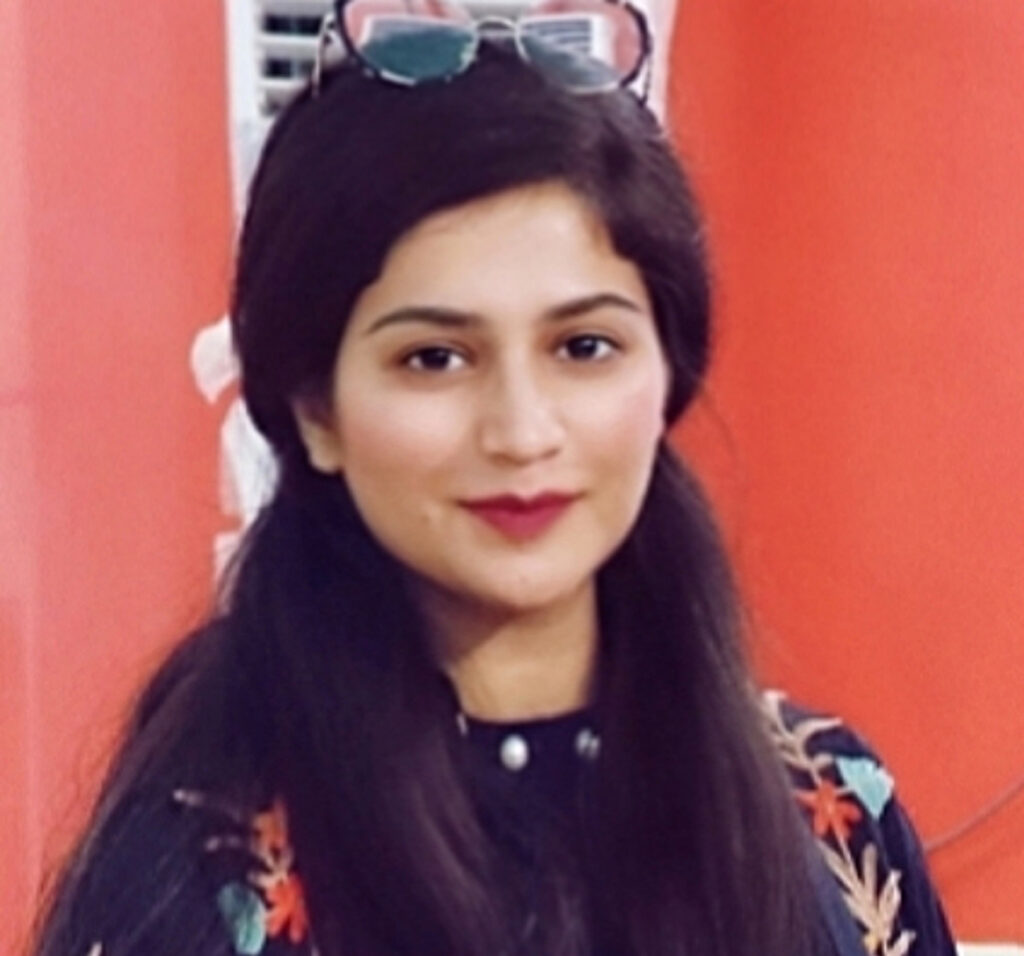
Elsa Chandio is a researcher and peacebuilding practitioner based in Islamabad. She serves as Research Fellow and Senior Project Coordinator at the Center for Research and Security Studies (CRSS), where her work focuses on Pakistan-Afghanistan relations, displacement, conflict, insurgency, human rights, and regional stability. She has conducted field research with vulnerable communities in Pakistan and represented the country at regional forums on migration and refugee narratives.