
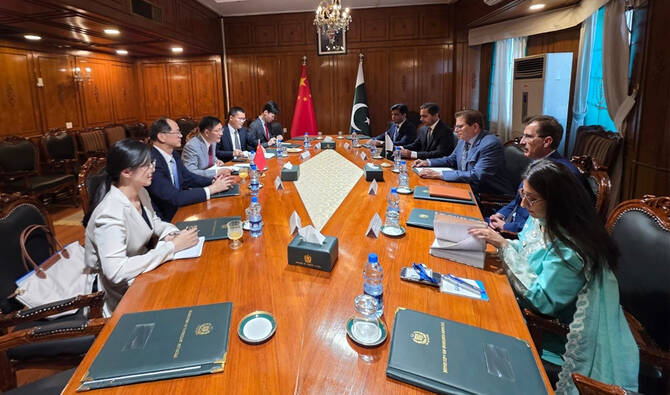
Pakistan’s special representative for Afghanistan, Mohammad Sadiq, said on Tuesday he had held talks with his Chinese counterpart on regional security threats, including militant groups operating from Afghan territory, as Beijing continues efforts to ease tensions between Pakistan and Afghanistan.
The meeting between Sadiq and Yue Xiaoyong comes after months of heightened friction between Islamabad and Kabul, including cross-border clashes, Pakistani airstrikes inside Afghanistan and accusations by Pakistan that the Taliban administration is allowing militant groups to use Afghan soil to launch attacks. Kabul denies the allegations and says militancy inside Pakistan is an internal issue.
“Held productive talks on regional security, including threats from TTP and ETIM operating from Afghan soil,” Sadiq wrote on X.
“Agreed to strengthen coordination & synchronize counter-terrorism efforts to protect regional peace & stability.”
The Tehreek-e-Taliban Pakistan (TTP), an umbrella group of Islamist militants, has carried out some of the deadliest attacks inside Pakistan in recent years. Islamabad says many TTP fighters operate from sanctuaries across the border in Afghanistan, a claim rejected by the Taliban government.
Pakistan and China have also repeatedly raised concerns about the Eastern Turkistan Islamic Movement (ETIM), which Beijing accuses of seeking to establish an independent state in China’s Xinjiang region.
The talks took place against the backdrop of China’s increasingly active role as a mediator between Pakistan and Afghanistan, driven partly by concerns that instability could threaten regional connectivity projects and Beijing’s economic interests in the region, including the multi-billion dollar China-Pakistan Economic Corridor (CPEC).
Relations between Pakistan and Afghanistan deteriorated sharply earlier this year after deadly border clashes escalated into the worst confrontation between the neighbors in years. Pakistan launched airstrikes inside Afghanistan in February, accusing the Taliban of harboring militants, while Kabul condemned the attacks and denied providing support to armed groups.
Since then, China has intensified diplomatic efforts to prevent a wider conflict. Chinese Special Envoy Yue conducted shuttle diplomacy between Islamabad and Kabul in March, while Beijing hosted direct talks between Pakistani and Afghan officials in the northwestern Chinese city of Urumqi.
Chinese officials have publicly urged both sides to resolve disputes through dialogue rather than military action and have backed efforts toward a ceasefire and broader political understanding.
In April, Pakistan and Afghanistan resumed talks in China aimed at reducing tensions and exploring a longer-term framework for addressing border security, militant activity and economic cooperation. Both sides later described the discussions as constructive, while China said the dialogue process was making progress.
Source: Arab News